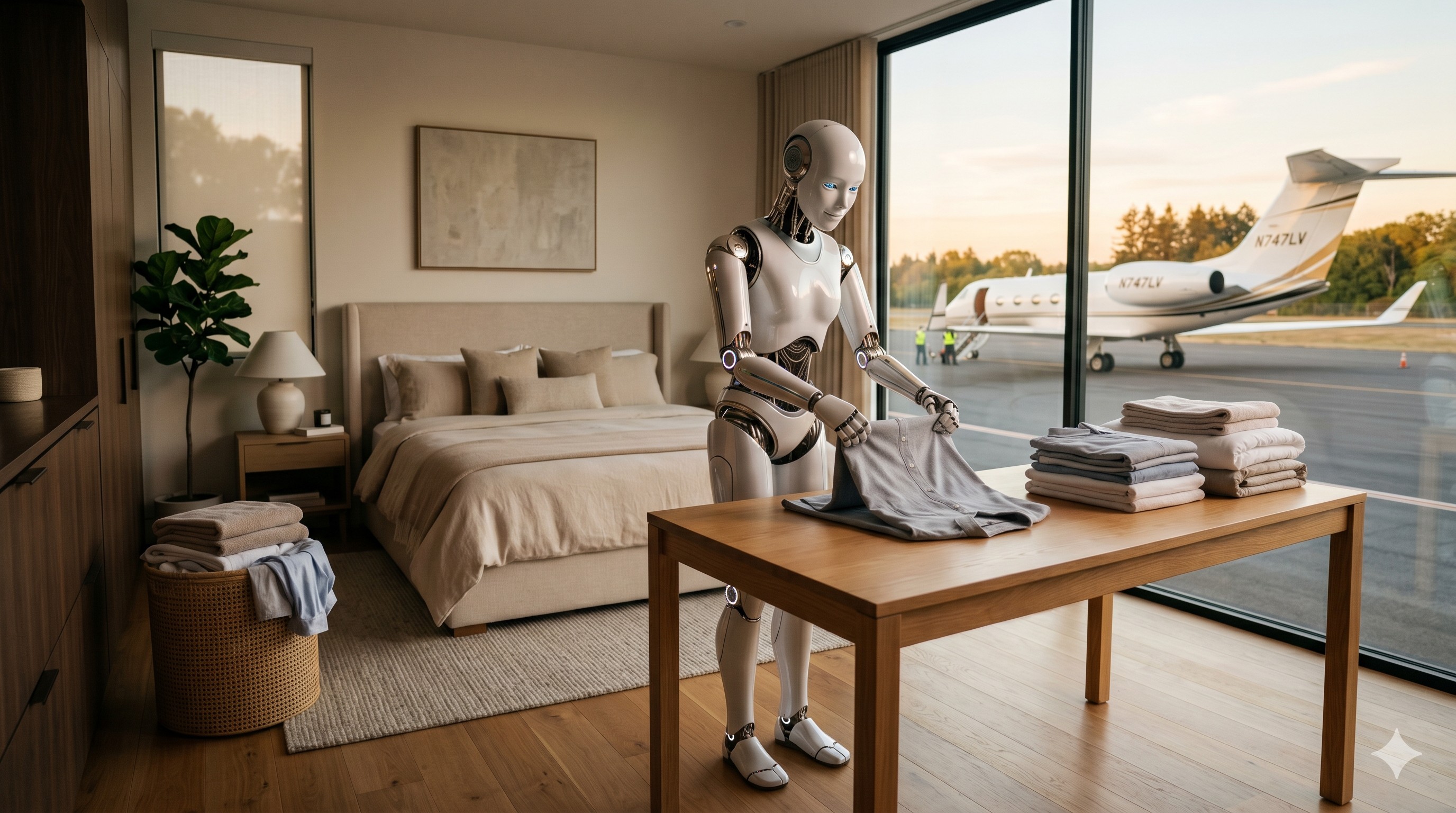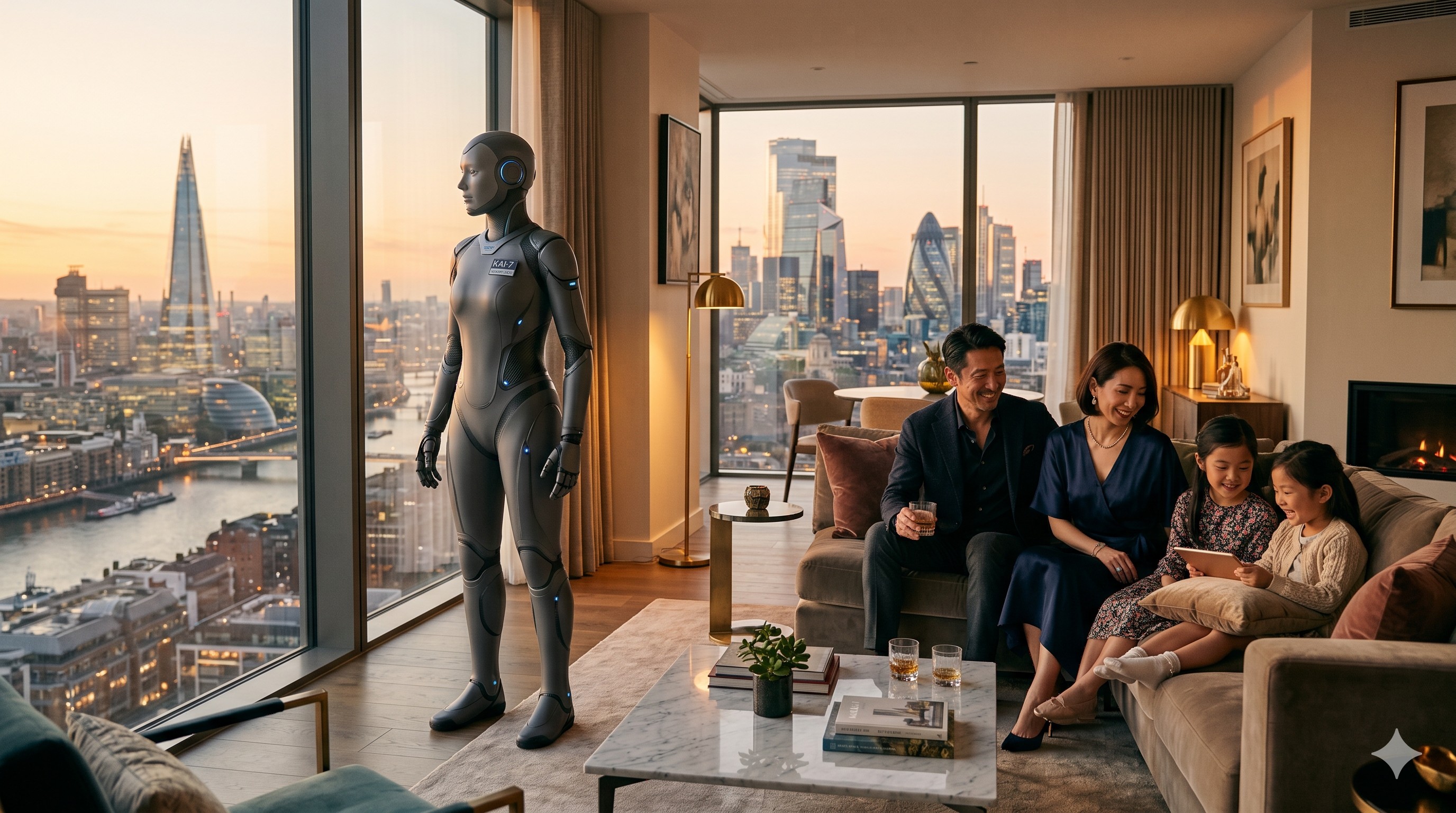
You relocate from Honolulu to Geneva to Singapore. Your standards do not change. Your routines do not change. And from 2026, neither does your household staff — because it was never human to begin with.
"2026 is the year humanoid robots stopped being conference demos and started doing real work. The domestic deployment window is open."
BuildMVPFast · Humanoid Robot Deployment Analysis · 2026For decades, humanoid robots were the most reliable punchline in technology forecasting — perpetually five years away from commercial reality. 2026 ended that joke. The machines are deployed. The factories are running. The consumer pre-orders are shipping. The question is no longer whether Physical AI will enter the home. It is who designs the integration first.
The humanoid robot market forecasts vary by methodology — but every credible research firm agrees on the direction. This is not a niche technology. It is a platform shift of the same magnitude as the smartphone — and the deployment window for first-mover advantage in the luxury residential segment is open right now.
| Research Firm | 2025 Market Size | Projection | CAGR | Key Driver |
|---|---|---|---|---|
| Goldman Sachs | — | $38B by 2035 | — | Industrial + personal assistance convergence |
| Morgan Stanley | — | $5 trillion by 2050 | — | 1 billion+ units; mass industrial and consumer deployment |
| MarketsandMarkets | $2.92B | $15.26B by 2030 | 39.2% | Personal assistance & caregiving segment leads |
| Fortune Business Insights | $4.89B | $165B by 2034 | 50.6% | Asia Pacific dominance; hardware complexity |
| Bank of America | — | 1M units/year by 2030 | — | Price drop from $35K (2025) to $17K (2030) |
| Research Nester | $3.14B | $81.55B by 2035 | 38.5% | Household adoption acceleration post-2029 |
GLO does not commit to a single hardware vendor. The integration strategy is platform-agnostic — selecting the optimal humanoid for each deployment context, from FBO hub logistics to residential household management to children's learning support.
The fundamental promise of Global Lifestyle OS is consistency of standard across geographies. Physical AI makes that promise structurally achievable for the first time. A GLO member moving between Honolulu, Geneva, and Singapore does not need to find, vet, train, and manage new household staff at each location. The standard travels with them — embedded in the platform.
The UHNWI household has always required exceptional staff — chefs, housekeepers, security personnel, personal assistants. Recruiting, vetting, training, and retaining this staff in a single location is a significant management burden. Replicating it across three or four residences in different countries is an operational challenge that consumes time, energy, and capital.
Physical AI eliminates this constraint entirely. The GLO platform integrates verified humanoid systems into member residences and FBO hubs — configured to each family's specific protocols, preferences, and routines. When the family moves, the configuration moves with them. The AI learns and adapts continuously. The standard does not degrade across borders.
Every transformative technology follows the same trajectory: early luxury adoption, rapid price compression, mass market commoditisation. The moment to establish the premium integration model is before the commodity phase begins. That moment is now.
"The era of the domestic humanoid has officially begun — not with a bang, but with a pre-order page. For those willing to pay a premium to live in the future today, the window is open."
RoboHorizon · 1X NEO Consumer Analysis · October 2025
Global Lifestyle OS · Physical AI
The question is not whether Physical AI will transform the UHNWI household. It already has. The question is who designs the integration — and who lives with the standard everyone else will eventually try to imitate.